At the 16th German Mechanical Engineering Summit, Beckhoff demonstrated how AI is already transforming engineering, control systems, and service today

Physical AI: It is not the technology that is holding back machine building, but the hesitation to apply it
The 16th German Mechanical Engineering Summit took place on November 10 and 11, 2026, with “Shaping the future” as its main theme. Hosted by the VDMA (Association of German Mechanical and Plant Engineering) in collaboration with Produktion, a mi-connect trade journal, the Summit brought together leading representatives from industry, research, and politics. The focus was on industrial policy, Europe’s role, Germany’s ability to compete as a business location, and the future of industrial production.

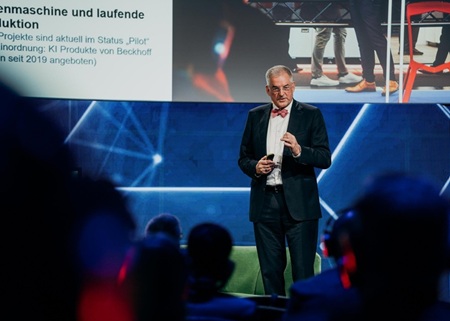
Gerd Hoppe, Corporate Management, Beckhoff Automation: “The machine building industry has the expertise to successfully implement physical AI. It’s now a matter of turning this knowledge into concrete applications at speed. Photo: © Beckhoff
The session “Physical AI/Embodied AI: When AI enters the machine” spotlighted key questions for the machine and system engineering industry. What role will the industry play in the era of embodied AI, i.e., AI combined with physical systems? Are machines evolving into learning agents? And just how close is that future, really? Gerd Hoppe from Corporate Management at automation specialist
Beckhoff Automation answered these questions not with visions of the future, but with observations from live projects. His conclusion?
Physical AI has already found its way into specific applications – in AI-assisted development, in the analysis of process and diagnostic data, in image processing, and in real-time decision-making directly within machine control systems.
“The key question is no longer whether AI works in machine building. We need to be asking where we start, what context we provide, and how we evaluate the results,” says Gerd Hoppe. “Those who are piloting real-world applications today are gaining a decisive edge in experience – not by waiting, but by taking action.”
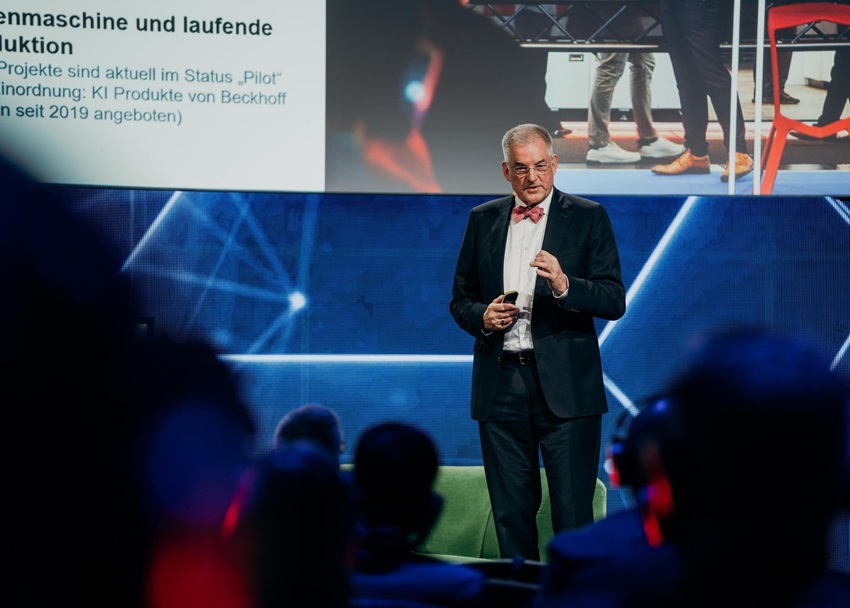
Gerd Hoppe, Corporate Management, Beckhoff Automation: “Despite all the benefits of AI, engineers remain indispensable. They describe the desired function, provide the application context, verify the results, and are responsible for approval, machine safety, and commissioning. Photo: © www.eventfotosberlin.de
AI works inside the machine – not just alongside it
Physical AI provides a connection between AI models and the physical world of the machine. It processes images, sensor data and process data, internal control variables, and technical documentation, and can use this information to determine actions in the machine process within clearly defined limits. As a result, AI is evolving from an isolated tool into an integral part of automation.
The key factor here is not just the performance of a language or image model. The true impact is felt when AI is provided with the full context: access to control systems, processes, engineering data, and machine knowledge. AI can only provide reliable support in engineering, diagnostics, or operations if it understands the actual machine and its processes.
“The last mile to the machine process is becoming the decisive factor,” says Hoppe. “AI takes full effect not by providing the most general answer possible, but when it has full and verifiable access to the automation context.”
From AI-assisted engineering to agentic machine
Applications range from AI-assisted code generation to training and running deterministic machine learning models and even include agentic engineering workflows. AI can handle repetitive tasks, analyze existing automation projects, generate code suggestions, prepare configurations, and identify errors in extensive diagnostic information. Hoppe used specific examples to demonstrate, among other things:
- how existing systems can be modernized efficiently based on existing circuit diagrams, PLC programs, and operating information
- how AI supports the migration of automation projects and structures engineering artifacts
- how multi-modal quality checks can be performed directly within the real-time process
- how diagnostic AI agents can find sporadic errors in large log files more quickly and generate analysis reports
- how service agents use locally operated language models to make machine knowledge available without sharing it outside the company
- how agent-based models directly influence the process flow by interacting with the machine’s control system
Engineers remain indispensable in this regard. They describe the desired function, provide the application context, verify the results, and are responsible for approval, machine safety, and commissioning. AI does not, therefore, remove engineering work from the process. On the contrary, it creates space for more challenging and creative tasks that add genuine value.
Openness and local operation provide room to maneuver
From the point of view of machine builders and operators, data sovereignty, the protection of process knowledge, and the avoidance of new dependencies are key prerequisites for the use of AI. Beckhoff therefore relies on open interfaces, model-agnostic architectures, and the ability to run AI models locally on an industrial PC.
Companies can decide for themselves which models to use, where to run them, and what data to make available to the respective applications. Sensitive machine and process knowledge can stay in-house yet, at the same time, the selection of AI models and operating modes remains flexible.
“Sovereignty does not come from a blanket rejection of AI or cloud services,” says Hoppe. “It arises from an architecture that preserves freedom of choice in terms of models, location of operation, and access to one’s own data.”
Speed of implementation is becoming a competitive factor
AI innovation cycles are evolving much faster than traditional investment and decision-making processes in machine building. It is precisely this that Hoppe sees as a risk to Germany’s competitive ability as a business location. Companies that move quickly into concrete applications accumulate data, experience, and process knowledge, thereby gaining a competitive edge that goes far beyond simply having access to individual models.
Machine building specifically is in a strong starting position, as it boasts in-depth process and domain knowledge, integration expertise, and close ties to actual production. These strengths must now be connected to a faster pace of implementation. “The technology is already here,” concludes Hoppe. “What’s holding us back is the decision to take action.”
About Gerd Hoppe
Gerd Hoppe studied electrical and telecommunications engineering at TU Dortmund University. He joined
Beckhoff Automation GmbH & Co. KG in 1994. After holding various positions in sales, marketing, and product management, he headed up the establishment of Beckhoff’s US subsidiary in 1998 as managing director, driving the long-term expansion of the international sales network. Hoppe was appointed to the management team at Beckhoff Automation in 2003 as COO. Since then, his responsibilities have included general consulting and sales in addition to intellectual property, legal, and compliance matters related to products, business processes, and collaboration with partners.
His many years of experience in the implementation of open automation technology in the machine and system engineering sector enable him to make an active contribution to the company’s dialogue with policymakers and industry associations. In addition, Gerd Hoppe is committed to promoting the interests and future issues of the automation and machine building industries. He currently serves as vice chair of the Electrical Automation trade association within the VDMA and sits on the board of the Open Industry 4.0 Alliance, holding the position of vice president. In recent years, he has also played an active role in shaping key data space initiatives, both as a member of the founding board of the European Gaia-X initiative and in the development of the Manufacturing-X ecosystem.
About Beckhoff Automation
Beckhoff implements open automation systems using PC-based control technology. Its portfolio of products includes industrial PCs, I/O and fieldbus components, drive technology, automation software, control cabinet-free automation, and hardware for machine vision. The product lines are flexible for use as individual components or integration into end-to-end systems. Around the world, these solutions are used across a wide range of industries and in a variety of applications – from CNC-controlled machine tools to smart building automation.
This PC-based approach consolidates all processes on a central software platform to provide a technological foundation. High-performance industrial PCs handle control, motion, HMI, measurement technology, and communication. Beckhoff can make the connection between traditional machine functions and modern
IT applications. The result is high-performance system architectures with reduced complexity and a future-proof foundation for networked production environments.